Skip to content
The Empathic Social Observer

The Empathic Social Observer

Letters, longings and layered truths

  • Links
  • Contact
  • Explore My Writing
  • Links
  • Contact
  • About
  • Home

Category Archives: Reflections

A soft archive of moments that linger —
the echo after the ache,
the clarity that arrives when no one is watching.
These pieces are mirrors,
sometimes cracked, sometimes clean,
but always catching light.

THE MULTIPLICITY OF BEING


I was having a conversation with a friend when he flinched at the word submission. Not at the idea itself, exactly, but at the possibility that I might believe it. Or not.

He paused, then laughed awkwardly and said he wasn’t sure whether I was a feminist or not.

Take cover! The taboo word has been mentioned.


So I asked him, calmly, whether he thought it was possible for a woman to be a feminist and still value submission in marriage.

He thought for a moment, then said yes.

Then added, “When it comes to you.”

Hold on.

Before you toss your phone on the bed and kiss your teeth at another article you assume will spiral into a tired argument about feminism or submission, let me be clear: this is not that essay.

I’m not here to litigate or exalt feminism.
I’m not here to rehabilitate or condemn submission.

I have my beliefs about both, and perhaps in a future article I’ll share them. But that is not the work of this piece.

What stayed with me from that conversation was not his answer, though, but the reason behind it. He didn’t arrive at yes because the idea suddenly made sense. He arrived at yes because he had come to accept the complexity of my thinking and how that complexity disrupted his mental filing system.

I didn’t always fit neatly into the boxes he had prepared.

And that discomfort – that brief mental tightening – is what I want to talk about.
Because beneath many of our loud cultural arguments is a quieter, more revealing question – one most of us deny asking ourselves, or each other:

Is a person ever just one thing?

We live in an age that rewards speed – fast opinions, fast alignment, fast categorisation. We want to know what someone is so we can decide how to treat them, how much to listen, and whether they are “safe” to engage. Labels sell because they are shortcuts to understanding the human. They save us time. They save us effort. They save us from the exhausting work of holding complexity.
But they also flatten people.

They silence people. I have been a perpetrator, and a victim of this existential laziness, sometimes even to self, unable to sit with inner chaos.

Amidst the laziness lies my almost obsessive curiosity, which has sometimes become detrimental. Another article.

Nevertheless, my own thinking is deeply shaped by my faith – not as a weapon, not as a demand, but as a lens. I don’t force it down anyone’s throat, but I also don’t pretend it doesn’t shape how I reason. And within that faith is an idea I return to often: that God is not singular in expression. Father. Son. Spirit. One being. God the protector; God the raging fire; God the lover; God the judge. I Am. Multiple manifestations, same God.

If humanity is said to be made in that image, why are we so disturbed by multiplicity in each other?

Why do we tense up when a person refuses to be ideologically tidy?
Somewhere along the way, we started mistaking coherence for purity – believing that to be credible, a person must be consistent in the narrowest sense. No contradictions. No tensions. No apparent opposites. But real humans are not essays written to prove a point. We are lived, layered, unfinished.

Walt Whitman once wrote, “Do I contradict myself? Very well, then I contradict myself.”  Chimamanda’s warning about the danger of a single story wasn’t just about misrepresentation – it was about intellectual laziness.

Because categorising people quickly allows us to move on to more self-absorbed pursuits. Once I’ve decided what you are, I no longer have to stay curious. I no longer have to sit with the discomfort of not knowing. I can dismiss, applaud, or argue with a version of you that fits neatly into my worldview.

And maybe that’s the real problem.
Not that people hold opposing ideas – but that we’ve grown impatient with the effort it takes to understand a whole person. Little wonder, then, that people are unsettled by curiosity. It feels invasive, almost indecent – as though they’ve forgotten that the Creator’s greatest masterpiece is the human being: physical, physiological, psychological, even spiritual. To explore oneself – and another – is a lifelong undertaking, one worth waking up for every morning.

So, I keep returning to that moment in the conversation. Not to correct my friend. Not to defend myself. Not to revel in some sense of superiority or acknowledgement, but to sit with the unease beneath it.

Why did my being “an exception” feel safer than questioning the box itself?

And how many people do we misunderstand,  not because they are unclear, but because we demand clarity too cheaply, too quickly?

Meestique

The Empathic Social Observer.

Posted byChinweezechukwuJ January, 2026J January, 2026Posted inFaith in Fragments, POETRY, Reflections, Still Soft, Still Sharp, The Empathic Social Observer, The Gaze & The Girl, UncategorizedTags:Faith Reflections Christian Writing Biblical Inspiration Psalms & Prayer Spiritual VulnerabilityLeave a comment on THE MULTIPLICITY OF BEING

Dear Mr. Robert Greene,

[Final piece of The Economics of Softness series]


A letter from someone who feels deeply, yet wants to master the game.

There’s something about your books – The 48 Laws of Power, The Art of Seduction, The 33 Strategies of War – that made me pause. Not because I didn’t understand them, but because I did.

Perhaps too well.

They opened my eyes to a new way of seeing people: first through suspicion, then fascination. And now, I find myself somewhere between curiosity and pity. Not pity born of condescension, but of why.

You write like an observer behind a one-way mirror – cool, deliberate, unflinching.

But I wonder if that’s the full story. To understand manipulation, seduction, and psychological leverage so intimately, one must have felt them deeply. Painfully, even.

No one writes with that kind of precision without scars.

I am a soft person, Mr. Robert. Not weak – just someone who sees too clearly and feels too much. The kind of person people underestimate, then later label “intimidating” when I speak with softness and structure.

Your books taught me that power often wears a polite smile. That vulnerability can be used as a mirror – or a weapon. That perception frequently wins over truth.
And yet, this is where I struggle.

How do I protect my heart without burying it?

How do I learn the game of influence without turning cold?

How do I sharpen my instincts without dulling my empathy?

I know now that being “good” isn’t enough. But must I become cunning to be safe? Must I ration softness to be respected? Must I observe in silence when what I long for is connection?

You write as though power is a necessity – and perhaps it is. But I wonder about the cost. About your cost. What did you have to bury to see the world so clearly? Did your heart ever resist your mind?

If I could ask you one thing, it would be this:
Can someone like me – empathic, intuitive, assertive but emotional – ever master power without losing themselves?

I don’t want to become hardened. I just want to be safe in a world that punishes softness. I want to lead, love, and influence with presence, not pretense.

Maybe what I’m searching for is a different kind of power – one rooted in clarity and compassion. One that doesn’t pretend emotion is weakness. One that doesn’t require a mask to be effective.
If you’ve found it, even in glimpses – write back.

With sharp admiration and a soft heart,

Meestique

The Empathic Social Observer

Posted byChinweezechukwuJ January, 2026J January, 2026Posted inReflections, Still Soft, Still Sharp, The Empathic Social Observer, The Gaze & The Girl, The Soft Strategist's CorrespondenceTags:Softness Shame Leverage Emotional Economy Power and VulnerabilityLeave a comment on Dear Mr. Robert Greene,

WHAT SHAME DOES TO LEVERAGE

[Second post of my End-of-year, now turned New-Year series]


We hardly ever talk about the economic side of softness, or love. And by “we,” I mean women. Especially now, when “love” is being peddled like thrift – the unholy transaction of love for money.

We are shamed for demanding any form of exchange, and for some of us who are constantly fluid in our becoming, even the thought of it makes us cringe.

Shame.

Where does it spring from? Does it even spring?

I believe it calls, whispers, yells, and slaps us atop our heads, because shame isn’t a garment merely thrust upon a person. It is an insidious companion that sneaks in and never leaves. It comes to reside like a shadow, sitting quietly in the corner. That brutal, stern judge that reprimands.

Yep. That’s shame.

“I am ashamed that I’ve given so much without returns.”
“I am ashamed that I can not just walk away.”

These statements may resonate instantly with my audience, because if you read my blog, you must be someone who values presence, kindness, generosity – all the qualities that make love worthwhile.

But what about the shame?

I wish to acknowledge it.

Where does the external shame lie?

In unreciprocated giving, which feels like failure.
It hints at indiscipline, scatteredness, a lack of agency over oneself. And the worst blow of all: low self-esteem.

Then there is the internal shame – the one that gnaws at the limbs like neuropathy: the weakness of not walking away. One that contradicts self-preservation – the absurdity of it all.

That we stayed after understanding the cost.

Not out of morality, but out of attachment. Out of hope. Out of a delayed willingness to withdraw. This is the shame that feels personal, because it implicates agency: a gap between how capable we know ourselves to be, and the execution of it. A gap closed by willpower.

My mother would always say, “We are not business-minded in this family.” And I choose to think of our proclivities in those terms.

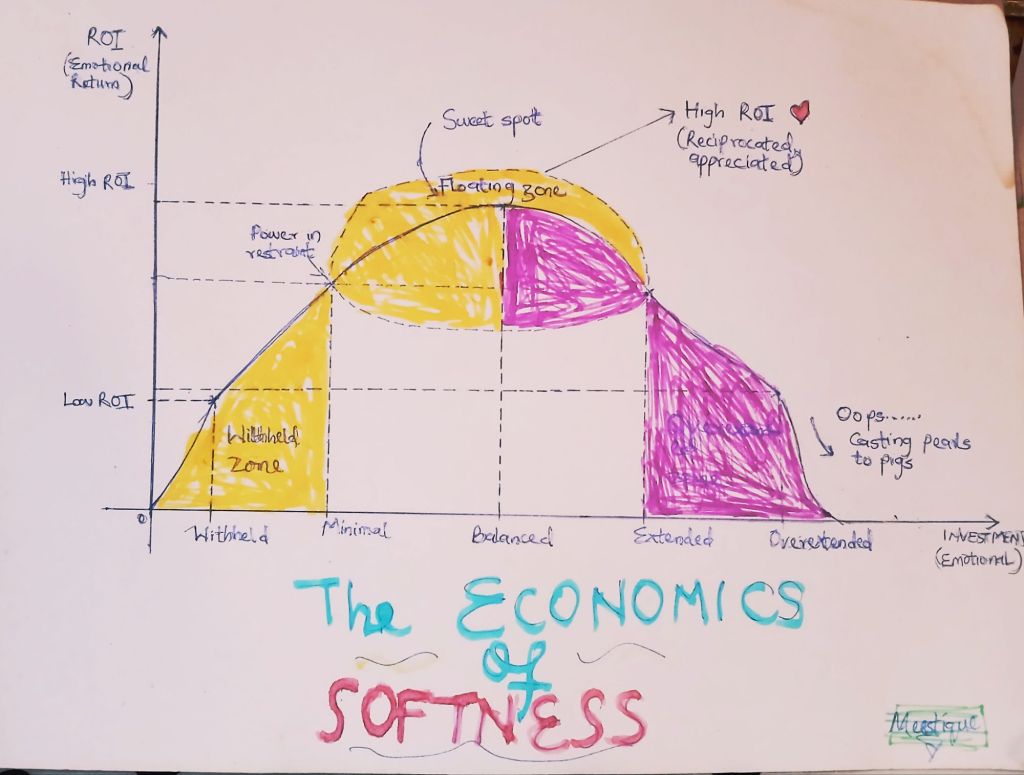
Economics and business have long given language to what we often glaze over, what we decide to ignore. They tell us that when supply increases and demand does not, value falls.
When input continues past its optimal point, returns diminish – then turn negative.
In any negotiation, the party with the strongest alternative to walking away holds the most power.

My dear softies, the ability to leave is not cruelty. It is leverage.

Even as I think on paper, I deduce that shame isn’t always a bad thing, something to be resisted. In this context, it is not moral or personal failure – an affront on one’s self-esteem – but feedback from a mispriced exchange. A reminder that softness, like any resource, requires structure to retain its value. Leaving is not the opposite of love. It is sometimes the condition that makes love possible without forgetting oneself.

Meestique,

– The Empathic Social Observer.

Posted byChinweezechukwuJ January, 2026Posted inReflections, Still Soft, Still Sharp, The Empathic Social Observer, The Gaze & The Girl, The Soft Strategist's CorrespondenceTags:Femininity Unscripted Softness & Structure Emotional Integrity Nuanced Womanhood The Empathic Social Observer Auditioning for Approval Younger Generation of Women Language & PowerLeave a comment on WHAT SHAME DOES TO LEVERAGE

IF I WERE A MAN

[First piece for my End of Year series – The Economics of Softness]


If I were a man,
coldness would pass as sense.
As expected.

Distance would be mistaken for discipline.

As a woman, I learn – later than expected –
that softness is an unprotected resource.

No one warns you
how a certain brand of loving gathers shame
the kind that is generous,
the kind that gives to create art,
that keeps investing
with poor returns.

Power, I discover,
is rarely in expression.
It resides in restraint.
Ultimately, in leaving.

There is a particular cruelty
in being valued for openness
by those unwilling to safeguard it.

Like a child,
you are not a threat.
You can be taken from
without fear of retribution.

Detachment, in men,
is interpreted as clarity.
In women, it is read as loss –
of warmth.

I am afraid
I will lose the femininity I searched for,
the one I now float in,
revel in.

And so I remain careful
with what I offer.
Not hardened,
but precise.

Softness, I now understand,
requires boundaries
as much as it requires courage.

Meestique,

– The Empathic Social Observer.

Posted byChinweezechukwuJ December, 2025J December, 2025Posted inReflections, Still Soft, Still Sharp, The Empathic Social Observer, The Gaze & The Girl, The Soft Strategist's CorrespondenceTags:Softness Shame Leverage Emotional Economy Power and VulnerabilityLeave a comment on IF I WERE A MAN

IF YOU HAD TO PICK

by Meestique, The Empathic Social Observer.

Choosing peace over polish in a world with perception.

Photo by: Matsvei Liatkouski

https://unsplash.com/photos/a-delicate-blue-butterfly-rests-on-a-pink-flower-3KkEfjC_I-Q?utm_source=unsplash&utm_medium=referral&utm_content=creditShareLink

If you had to pick—being seen as put-together, or actually feeling light inside—which one would you go for?

I’ve been thinking about this a lot lately. How easy it is to chase the perception of calm, of grace, of “she has it all together.” And how quickly that demeanor becomes a second skin. You start adjusting your posture, your tone, your responses, until even your silences are curated.

But peace… real peace… doesn’t ask for an audience. It’s quieter. It’s messy sometimes. It’s the kind that lets you exhale mid-conversation, or say “I don’t know” without shame.
It’s the kind that lets you cry when you’ve been hurt—even to the one who hurt you.
The kind that lets you say out loud, “this is what I need,” even when those needs sound utterly ridiculous.
It’s the kind that lets you ask for help when you don’t gat it, that finally lets you accept yourself and others.
It quiets the looping replays of conversations you wish you’d handled differently—yet lets you sit with the three versions of you while you all converse, even argue, in your head.
It’s the kind that lets you forgive people—and yourself—quickly, even when they never asked for it.
It’s not glamorous, but it’s light.

And yet, the world rewards polish. It rewards the ones who look unbothered, who have the perfect caption for every chaos. So we learn to glow on cue, to look fine even when we’re fraying inside.

Maybe that’s why I asked the question in the first place—because I’m realizing how exhausting it is to be perceived. How tempting it is to trade peace for perception.
Yet perception is important o—don’t get me wrong. But if I had to pick…

Maybe this is a small rebellion: to choose lightness instead of poise.

Still, your girl is going to slay every day o. I’m not about to step out of my house looking homeless.
But that’s not the point.
The point is—I’d still choose inner peace. Because whether I’m feeling put-together or not, I will just be.
And I’ll let others be, too.
And somehow, that will be enough.

Posted byChinweezechukwuJ November, 2025Posted inAbuja Bougie Blues, Reflections, Still Soft, Still Sharp, The Empathic Social ObserverTags:inner peace self acceptance emotional wellness mindfulness authenticity vulnerability1 Comment on IF YOU HAD TO PICK

🎀💞THE ULTIMATE GUIDE TO LIVING IN MY SOFT, FEMININE ERA

“I’ve spent years studying everything except surrender.”
But I think this is what true softness means—to trust that God’s timing, not effort, births ease.


If you’re anything like me—someone who excelled in school and thought that achievement translated to success and wisdom in every area of life—then you must have realised by now how deceptive that mindset can be.

We were praised for working hard, for figuring things out, for mastering whatever we studied. But nobody warned us that this same mindset could become a kind of quiet self-destruction—the belief that we can fix, earn, or achieve our way into love, ease, or emotional safety. That if we study something long enough, we’ll eventually “crack the code.”
That may be true. But how worn down will you be by the time you finally crack it?

I realised quite early that I didn’t know much about men. I didn’t have a brother, and my dad was this towering, unknowable figure. So, to me, men carried a kind of mystique. I was fascinated by them in a way that bordered on obsession.
But fascination doesn’t guarantee understanding. Despite my effort, I failed at almost every romantic relationship I entered. Maybe because I was always drawn to the most complex, emotionally unavailable ones—the hardest puzzles to decode. My curiosity set me up for heartbreak.

The more I tried to “learn,” the harder I failed. It became a vicious cycle: no reward for my effort, only exhaustion. There were resentments here and there, but in typical Chinwe fashion, I kept hoping. Kept believing that one day I’d finally figure it out. The experts have a name for this condition, by the way — the anxious attachment style. Go figure.

Add that to my I-can-do-it attitude, and I became a chronic heartbroken-er. It’s been brutal. My self-esteem has dissolved and been rebuilt more times than I can count.
And yet, it was only today—while kneeling on the floor of my bedroom, crying and worshipping—that I realised something simple and profound: I could have invested all that energy into seeking God’s face about these “mystique” creatures of His.

That moment came with a wave of surrender. For once, I stopped trying to fix or decode, and I let go. I told my Heavenly Father, “Teach me. Give me ease where I’ve only known struggle.”

This realisation about my little knowledge of men has also opened my eyes to a far more humbling truth: I don’t know a lot about a lot of things. And maybe I was never meant to. The best way to navigate this life isn’t by gathering endless knowledge, but by submitting to the counsel of the Holy Spirit.
Ask me how He will guide me now, and honestly—I don’t even know. The only thing I know is that He dwells in me, and He will guide me in the way He knows I’ll understand for every situation.
And that, right there, is my conviction.

For as long as I can remember, relationships have been hard. I’ve blamed myself, convinced myself I was the problem. But then I asked, “Surely, it can’t be only me who’s defective?”
Imperfection is a human condition—so why should I be the only one suffering for mine while others, equally imperfect, find their people?
Maybe the unfairness was never in my lot, but in my perception.

I’ve seen God answer so many of my prayers. He’s broken barriers for me before. So maybe this time, instead of praying for “the one,” I should pray for understanding, patience, and grace. Because if there’s anything I’ve learned this year, it’s that His grace truly is abundant—just as Scripture says.

🩷💖From the Writer’s Journal:

This piece began as a lament but ended as a confession. I used to think strength meant doing, knowing, striving. But I’m slowly learning that it also means surrendering—to love, to uncertainty, to God.
Maybe the soft era is not about being delicate at all, but about being still enough to be guided.

Meestique,

The Empathic Social Observer😊

Posted byChinweezechukwuJ October, 2025J October, 2025Posted inFaith in Fragments, Reflections, The Empathic Social Observer, The Gaze & The Girl, UncategorizedTags:soft living soft life faith and femininity Christian womanhood becoming her woman of grace spiritual growth healing journey emotional maturityLeave a comment on 🎀💞THE ULTIMATE GUIDE TO LIVING IN MY SOFT, FEMININE ERA

PEARLS FOR MY LITTLE ONE: LETTER TO MY NIECE

Dear Mandy,

When I look back at grandma’s voice in my life, what echoes most is her steady insistence on self-worth. She spoke it not as theory, but as something she believed I deserved to hold onto—even when she herself was still learning what it meant. And isn’t that what mothers do? They plant seeds, even before they know the full tree that might grow from them.

However, self-worth without discernment is like honey without bees: sweet but defenceless.

For me, learning that balance has come in unexpected ways. Sometimes, it feels like laying out small riddles to the people I let close, just to see if they can read the language of my heart. It is not about trickery. It is about recognition. A person who sees you—truly sees you—will not stumble where swiftness is the honour due. People of worth can not sit comfortably with one-sidedness. Their spirit will press them to give something back.

They will not treat pearls like pebbles.

But here’s the part I want you to remember: withdrawing when the riddle is left unanswered is not cruelty. It is dignity. It is not pride to flinch at being mishandled. It is the soft, firm knowing of what you carry and the grace of refusing to lay it before blindness.

This, however, is not a call to live narrow or paranoid, constantly on defence. Life will bruise you regardless because no one is perfect—we ourselves, even with the best intentions, have hurt others unknowingly. The aim is not to build walls so high that you suffocate, but to recognize the urgency with which someone reaches for you. That urgency speaks volumes.

Perhaps that’s the second lesson, my darling: self-worth is not just a defence; it is also a gift. To know your own value is to walk lighter. It frees you from endless proving. You will test, yes. But you will also rest. Because what is truly for you will recognize you without delay.

Also, don’t forget that it is wisdom to leave people alone when they want to be left alone—another lesson I had to learn and weave into the balance of discernment.

I have an inkling, however, that you may not even need this particular lesson like your mother who, almost innately, seemed to find the balance. She knows when to draw close, when to step back, and how to honour herself without apology. For me, it was less natural. I had to wrestle with it, to learn by trial, to test and be tested in return.

And so my wish for you, little one, is that you will inherit the best of both: your grandmother’s steady voice, your mother’s quiet balance, and my hard-earned discernment. With these, you will walk sure-footed into the world, knowing that what you carry is treasure, and you are never less for expecting it to be treated as such.

With all my love,
Your Auntie.

The Empathic Social Observer.

P.S. Some people call it “playing oblivious.” I call it sparing yourself unnecessary battles. Not every invitation to wrestle deserves your strength.

Posted byChinweezechukwuJ August, 2025Posted inLetters to My Future Daughter, Reflections, The Empathic Social ObserverTags:letter writing personal letters aunt and niece family bonds generational wisdom reflective writing tenderness poetic prose literary letters legacyLeave a comment on PEARLS FOR MY LITTLE ONE: LETTER TO MY NIECE

WE WEAR SUNGLASSES SO YOU DON’T SEE THE FIRE BURNING IN OUR EYES.

3This is the first in a series of essays I’m calling “Abuja Roads”—a meditation on driving, fury, beauty, and what the road reveals about who we really are. I love this city. But I also want to fight half its drivers. Welcome to the contradiction.

1. On Lane Wanderers and the Indecision of Character

Abuja.
The beautiful city I grew up in. The only city I’ve really known as home.

The roads are wide, like they were designed for dreaming. And at this time of year, between the end of May and early June—the city is in bloom. The red-petal trees are in full performance, screaming against the lush green of roadside lawns and leaves, bold and unignorable. The colours clash and sing. And it’s clear: rainy season has begun.

The trees always announce it before the skies do. And whenever I see those petals scattered across the road like flower girls passed through, I know change is here—maybe in the weather, maybe in my skin.

There’s something about Abuja’s views that gives you that “inside-outside” feeling—like you’re both far away and deeply within something. The quiet neighbourhoods. The polite, well-dressed people who mind their business.

And yet.

Driving in this city I love has revealed another side of its soul. A microcosm of its collective psyche. The road has become its own kind of mirror.

Of all the things that trigger me in this life, nothing outranks the drivers who refuse to pick a lane. The ones who perch their vehicles on the lane markings instead of inside a lane. They sway from line to line like the roads were custom-designed for their indecision. As if being halfway here and halfway there is a strategy. As if everyone should wait while they figure themselves out.

I’m convinced this kind of driving speaks to something deeper: a certain kind of indecision about life itself. Or maybe it’s greed. Selfishness. The kind that keeps all options open, even if it means blocking others from moving freely along their own paths.

But maybe—just maybe—the intensity of my reaction also says something about me. Why do I get so triggered by indecision and dogged self-preservation? Why does that energy offend me on such a cellular level? I don’t know. But I watch it. And that tension alone is worth writing about.


2. The Elbow Men and My Inner Gore

Then there’s another group of drivers—mostly taxi men, mostly male—who love to hang their non-dominant arm out of the window like a soft flag of ego. Always relaxed. Always on display.

When I was younger, my mum told me they do it to show off—that they can drive with one hand. A testament to skill. Or masculinity. Or both. The way she said it stayed with me—not angry, just… detached. That tone mothers use when they’ve seen something foolish so many times that it no longer surprises them. Only bores them.

I wish I could assume that same posture in my mind.

Instead, I find myself nursing dark, ridiculous thoughts. Fantasies. That one day, a car will clip one of those arms clean off. Blood spurting, dismembered limb flying across the tar, finally coming to rest on the pavement. Just that one wild moment of chaos—enough to teach them to keep their body parts inside the damn vehicle.

Of course, I know where this comes from. I’ve watched one too many serial killer documentaries. Vikings. Game of Thrones. All that gore. But still, I marvel at how easily my mind goes there. I marvel at my own capacity for absurd rage. And yet… I keep watching.

3. The GLK Spirit (a.k.a. Carry Your Wahala and Go)

Next up: the drivers of the GLK.

You know them.
The big-bodied Benz SUVs that move like they were born with entitlement in their engine. The ones who drive like they paid for the roads. Who act like your lane is optional when they need space.

I’ve stopped arguing with them. I simply move. Let them pass. I file them under “arrogance that comes with wealth,” especially in a country like ours, where money is a kind of armour, and driving a GLK is less about transportation and more about domination.

Carry your wahala and go.

4. “Na Woman Dey Drive”: On Gender, Skill, and Fragile Egos

But no rant about Abuja roads would be complete without the classic line:
“Na woman dey drive.”

Every woman who’s ever driven in this city has heard it. Usually from the moment a man realises that it’s you, a woman, in front of him—obeying traffic laws, being cautious, not needing to impress anybody.

He says it with that special brand of contempt. Like it explains every traffic situation. Like it’s a diagnosis for slowness. Or uncertainty. Or just existing with ovaries and a driver’s license.

Sometimes I pause. I ask myself: is this still 2025?

Do they really think driving is some mystical masculine birthright? Do they not know that driving—like cooking, like cleaning—is a skill? That it’s learned through repetition, refined through experience? I work in a skill-based field. Every day, I see women perform delicate, precise, life-altering procedures. So why is steering a Toyota the line some men can’t cross?

Maybe it’s not about driving. Maybe it’s about power. Space. Control. The same script, new location.

Just yesterday, one man threw his sense into the gutter—trying to overtake me from the right side of a single-lane road full of potholes. Nearly scratched both our cars just to prove that he was The Man. I just shook my head.

Na wa o.
I rest my case.


5. But Just Before I Rest…

There’s still so much more to say. I haven’t even touched on the ones who reverse on expressways or the drivers who use hazard lights as an apology in motion. But one essay at a time.

Maybe the roads are just a stage.
Maybe we’re all performing—anger, masculinity, survival.
And maybe, just maybe, the car horn is our national dialect for “Notice me.”

So yes, I rest my case.
For now.

Meestique,

The Empathic Social Observer.

Posted byChinweezechukwuJ August, 2025J August, 2025Posted inAbuja Bougie Blues, Reflections, The Empathic Social ObserverTags:Abuja Roads Abuja Traffic Nigerian Drivers Driving in Abuja Road Rage City Life Nigeria Nigerian Culture Gender and Driving GLK Drivers Rainy Season in Abuja Urban Essays Roadside Observations NigeriaLeave a comment on WE WEAR SUNGLASSES SO YOU DON’T SEE THE FIRE BURNING IN OUR EYES.

THE QUIET WARS WE FIGHT

There are some battles you fight with your voice—loud, visible, dramatic.
But there are others where the battleground is your mind, your relationships, your inner silence. These are the kinds of wars you can’t always name, but you feel them…
In your discernment.
In the shift in the atmosphere,
In the part of you that knows something deeper is going on.

I’m not writing this to impress you with spiritual talk.
I’m writing this because I’ve seen firsthand how unseen wars can erode trust, twist perception, and try to mute your spiritual clarity.

So this is for anyone quietly fighting a war they didn’t choose, but can no longer ignore.

I’ve been thinking a lot about war lately.
Not the kind that makes headlines, but the kind that happens quietly—between the “Amen” and the argument, in the strange hollowness after worship, in the too-loud silence of a room where love once flowed freely.

Spiritual warfare.
We say it like we understand it, but most of us imagine either cinematic exorcisms or philosophical metaphors. Rarely do we recognize it in the moment it’s actually happening:

when forgiveness becomes impossible

when bitterness becomes seductive

when the perception of Christians and our faith in pop culture is one of weirdos and misguided fanatics

when to speak the truth of Jesus Christ makes you stand out as a troublemaker who doesn’t encourage logical thought

when sleep steals your prayerlife and offense becomes your love language.

Nobody tells you how sneaky the enemy is.
That he rarely knocks loudly. He whispers. He rewrites reality in small, believable sentences:
“You’ve failed again.”
“She doesn’t care about you.”
“Why bother?”
“You’re not enough.”

He is not creative, but he is consistent.
And if you are not armed, you are available.

Ephesians 6 is not poetic filler.
It is God’s strategy for people living behind enemy lines. Paul didn’t say, “Put on the vibe of resilience.” He said, Put on the full armour of God.
Because this war does not wait for you to feel ready. It doesn’t care about your calendar or your therapy appointment. It will attack you through your relationships, your emotions, your insecurities—and it often begins in your mind.

This is not a call to paranoia. It is a call to sobriety.
To know when what you’re feeling isn’t just hormones or mood or miscommunication—but a targeted scheme to rob you of joy, clarity, unity, and peace.

And in those moments, the real work is not to “win the argument” or “fix the situation.”
The real work is to stand.
To resist the temptation to return fire in the flesh.
To pick up your sword (Scripture), your shield (faith), your helmet (salvation), and pray like the war depends on it—because it does.

There is no soft way to be a soldier.
But there is grace.
Grace to stand even when your legs shake.
Grace to repent when you fall.
Grace to forgive when it costs you pride.
And grace to be alert—not anxious, but awake.

Because if you’ve ever felt like something invisible is trying to steal your peace, distort your love, silence your prayers, or drain your joy—
you’re not crazy.
You’re just in a war you were born into.

But child of God, you were also born to overcome.

This post is not the final word on spiritual warfare.
It’s a flashlight in a dark hallway—just enough light to help you reach for your armour again.

So if you’re in the thick of it, feeling misunderstood, misrepresented, or just spiritually numb—
Know this: you’re not alone. And you’re not powerless.

We fight from victory, not for it.

Posted byChinweezechukwuJ August, 2025J August, 2025Posted inFaith in Fragments, Reflections, UncategorizedTags:The Empathic Social Observer Chinwe Ezechukwu Raw Christian Writing Honest Faith Modern Christian Woman Thoughtful Christian BlogLeave a comment on THE QUIET WARS WE FIGHT

The Empathic Social Observer, Website Powered by WordPress.com.
  • Subscribe Subscribed
    • The Empathic Social Observer
    • Already have a WordPress.com account? Log in now.
    • The Empathic Social Observer
    • Subscribe Subscribed
    • Sign up
    • Log in
    • Report this content
    • View site in Reader
    • Manage subscriptions
    • Collapse this bar
 

Loading Comments...